dbbot Configuration and Single-Node Deployment Demo
Main example: deploy MySQL standalone instances (8.4.9, port 3306) on three machines concurrently. A 5.7.44 / 3310 legacy example is kept near the end to show how to customize an older MySQL deployment.
Use a fresh environment for deployment demos whenever possible.
single_node.ymlperforms Linux initialization by default, including dependency installation, SELinux changes, stoppingfirewalld, and managedsysctlupdates. It is not a good first run on an existing business host.MySQL
9.7.xusesglibc2.28packages and is not supported on the CentOS/RHEL 7 family; use MySQL8.4.xon those systems.
1. Optional: Upload the installation package in advance
If fcs_auto_download_packages: true in common_config.yml, dbbot can download the package automatically. Offline environments can upload the package to:
/usr/local/dbbot/mysql_ansible/downloads
Query the package name and download URL for the current operating system first:
cd /usr/local/dbbot
bin/dbbotctl support packages --stack mysql --version 8.4.9 --os <OS> --full
Replace <OS> with your OS type, such as CentOS7, RHEL9, or AlmaLinux9. In offline environments, upload the primary package from the query result to mysql_ansible/downloads.
2. Configure host inventory inventory/hosts.ini
[dbbot_mysql]
192.0.2.131 ansible_user=root ansible_ssh_pass="'<your_password>'"
192.0.2.132 ansible_user=root ansible_ssh_pass="'<your_password>'"
192.0.2.133 ansible_user=root ansible_ssh_pass="'<your_password>'"
Notes:
- Currently only
rootis supported for deployment. - Keep the password form as
"'password'".
3. Configure common parameters
Edit playbooks/common_config.yml:
mysql_version: "8.4.9"
mysql_port: 3306
advanced_config.yml is optional and can usually keep its defaults.
Default password notes:
- dbbot’s public default passwords follow
Dbbot_<user>@8888/Dbbot_<linux_user>@9999. - The default is
fcs_allow_dbbot_default_passwd: false, so if you do not change these passwords, the standalone demo is blocked bypre_tasks. - In production, change these passwords first and then run the standard command without
-e. - Only for quick validation in a non-production environment should you explicitly allow the public default passwords.
4. Perform standalone deployment
If you have already replaced the public default passwords with your own, run:
cd /usr/local/dbbot/mysql_ansible/playbooks
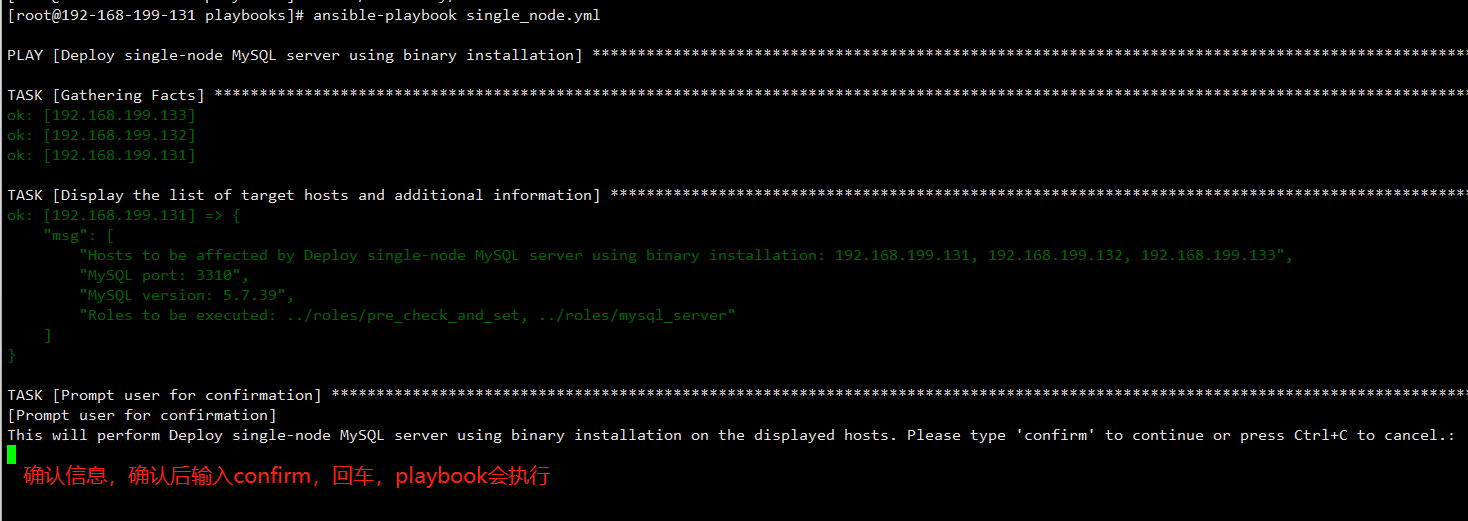
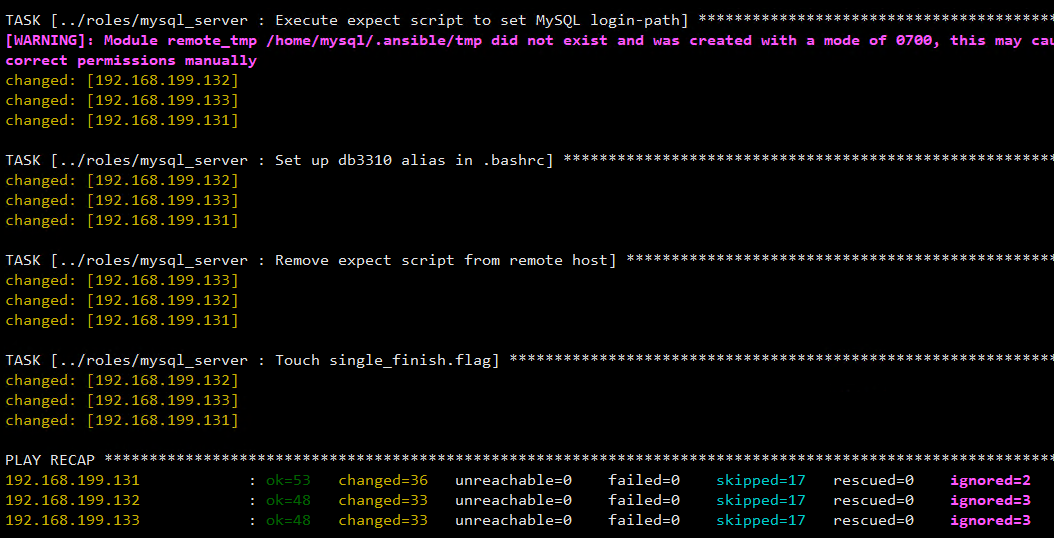
ansible-playbook single_node.yml
If this is only a non-production demo and you temporarily keep dbbot’s public default passwords, run:
cd /usr/local/dbbot/mysql_ansible/playbooks
ansible-playbook single_node.yml -e '{"fcs_allow_dbbot_default_passwd": true}'
Notes:
- The
-eexample above is only for non-production deployments. - If you run the command without
-e, replace the public default passwords first. Otherwise the playbook fails and stops inpre_tasks.
For scripts, CI, or SSH one-liners, pass dbbot_confirmation_input: "confirm" explicitly. Writing confirm to standard input is not a substitute for this variable:
cd /usr/local/dbbot/mysql_ansible/playbooks
python3 /usr/local/dbbot/portable-ansible/ansible-playbook \
  single_node.yml \
  -e '{"fcs_allow_dbbot_default_passwd": true, "dbbot_confirmation_input": "confirm"}'
5. Validation example
mysql -uadmin -h127.0.0.1 -P3306 -pDbbot_admin@8888 -e "select @@version"
If your inventory contains multiple [dbbot_mysql] hosts, verify all targets from the control node:
cd /usr/local/dbbot/mysql_ansible/playbooks
ansible -i ../inventory/hosts.ini dbbot_mysql -m shell -a \
  'MYSQL_PWD=Dbbot_admin@8888 /usr/local/mysql/bin/mysql -uadmin -h127.0.0.1 -P3306 -NBe "select @@version, @@port"'
Quick login is enabled by default. You can also run:
su mysql
db3306
6. Legacy customization example: 5.7.44 / 3310
To demonstrate an older MySQL deployment, change the common parameters to:
mysql_version: "5.7.44"
mysql_port: 3310
The matching offline package filename is:
mysql-5.7.44-linux-glibc2.12-x86_64.tar.gz
The deployment command stays the same:
cd /usr/local/dbbot/mysql_ansible/playbooks
ansible-playbook single_node.yml -e '{"fcs_allow_dbbot_default_passwd": true}'
Validate the legacy instance:
mysql -uadmin -h127.0.0.1 -P3310 -pDbbot_admin@8888 -e "select @@version"
su mysql
db3310
Pre-deployment checklist
inventory/hosts.inihost information is correct.playbooks/common_config.ymlcommon parameters are correct.playbooks/vars/var_xxx.ymlplaybook-specific parameters are filled in.- Optional:
playbooks/advanced_config.ymladvanced parameters are confirmed.